
The historic center of Oliva in the region of La Safor is one of the largest in the area and is made up of a series of traditional Valencian style houses from different periods, from the most humble to the stately. All this in a relief somewhat «steep» at some points but most of the time accessible to everyone.
Discover the Oliva illustrated guide
and the collection of watercolors about the municipality.
The exact origin of the town of Oliva is a mystery; although some specialists date it back to before the Muslim conquest of the 8th century, we don't need to know for sure to be able to stroll through its streets and step back in time.
We can divide the old town into three areas: the Raval, the Pinet and the Vila Condal
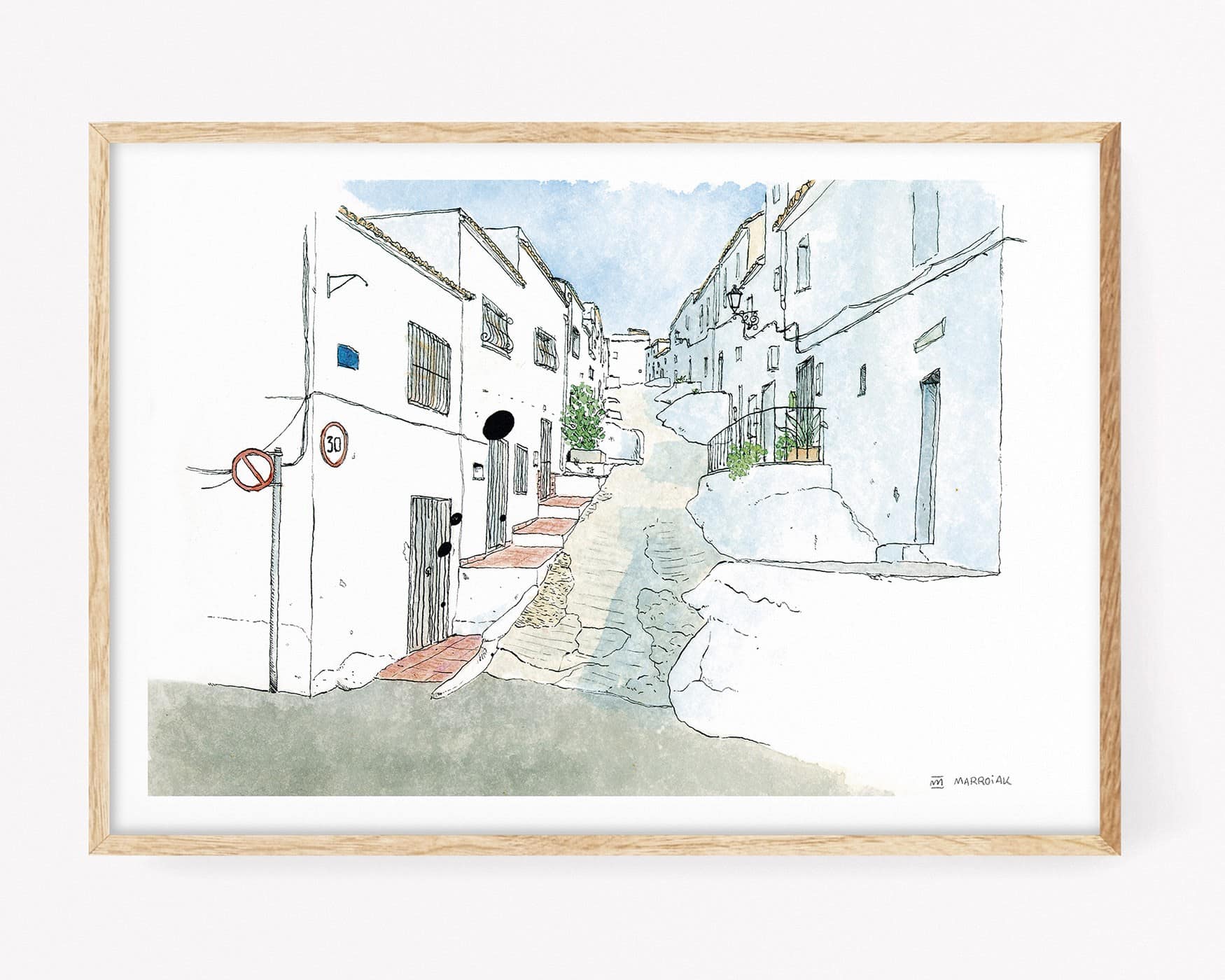
La Hoz street in the Raval neighborhood, Oliva print. Available here
The Raval
This charming neighborhood was the former home of the Moors after the Christian reconquest. The architecture here is more humble and minimalist. With its thick walls and whitewashed facades, you can see a construction pattern that is repeated without major variation throughout the Mediterranean. A maze of steep alleyways makes this walk a peaceful experience that will transport you back to the years of harmonious Christian and Arab coexistence.
Key points in the Raval neighborhood:
Casa Abadia. This is a building of Mudejar origin, a representative example of popular architecture from the 17th and 18th centuries.
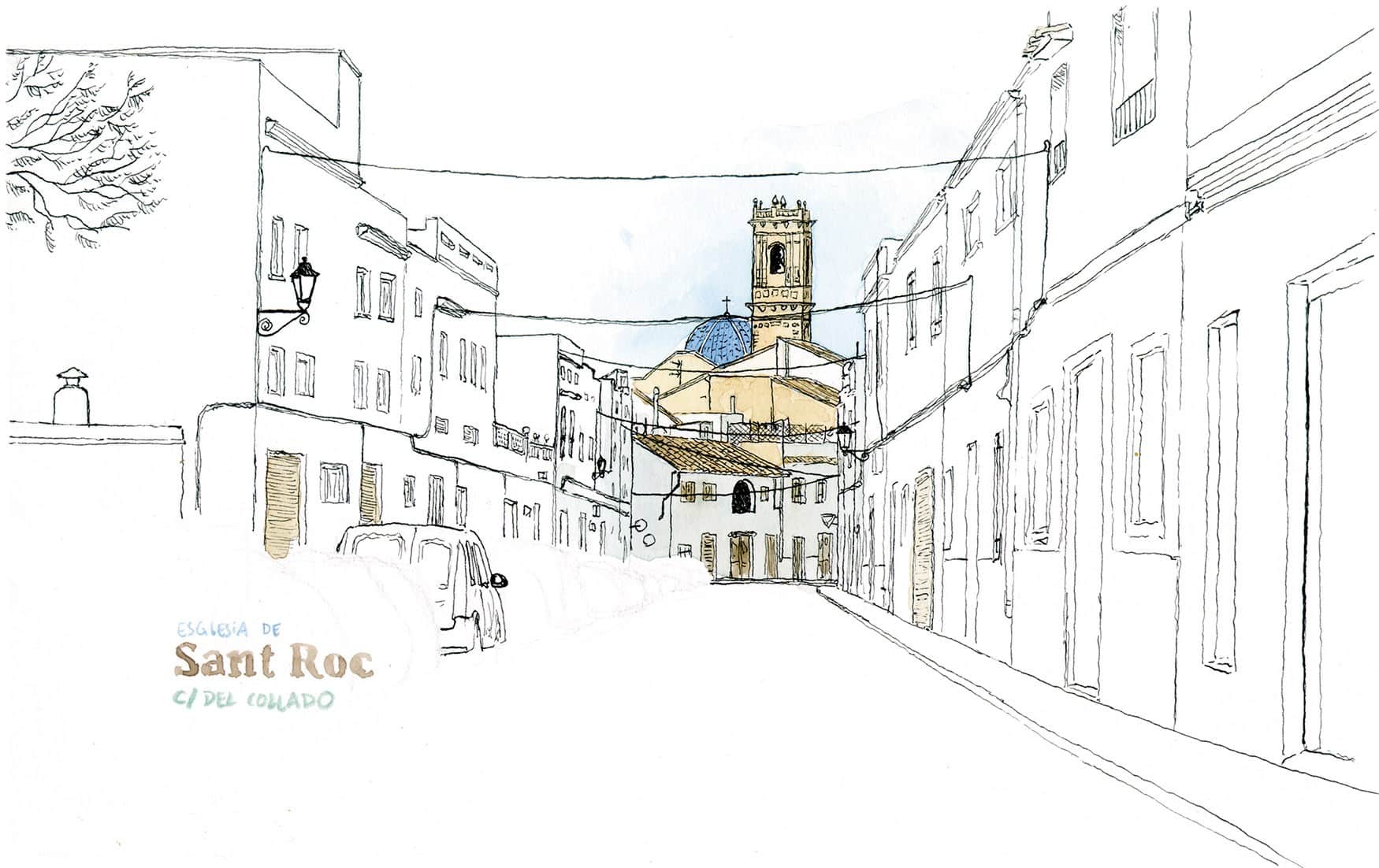
Església de Sant Roc. It has its roots in the Muslim community that occupied the suburb in the middle of the 15th century. The current temple is from the 19th century, except for the chapel of Christ, which dates from 1749. The chapel, an authentic baroque jewel, and the frescoes in its domes are worth highlighting.
Tossalet del Doix. Tossalet del Doix is one of the highest points in the suburb. From here, we have a privileged balcony to contemplate all the shades of blue (tiles, sky, and sea), Santa Maria in the background, and an imposing foreground of the church of Sant Roc, whose unique shapes of the artistic interplay of domes stand out.
Calle de la Hoz. Due to its modest houses built on the rock in the 16th century and its steep “L” shape, it is one of the most peculiar in Oliva. We can walk along Pou d’Alzina street, which still preserves the Muslim layout and the well that gives it its name.
This unique corner soon attracts the eye because of the well that gives the street its name. Its name, Alzina, reminds us of the Arab names and the Moorish families that inhabited the neighborhood.

Sheet with an illustration of the street of the Mountain in the neighborhood of the Pinet, Oliva. Available here
El Pinet (Gerreria-Pinet)
Although the Gerreria-Pinet neighborhood has certain architectural similarities to the Moorish suburb, its origins date back later (probably from the 18th century onward). You'll find few historical monuments on this route, but in return, you'll receive the infinite pleasure of catching a glimpse of the atmosphere of Oliva before the arrival of tourism, cars, and televisions. A time when life was more peaceful and people enjoyed such mundane pleasures as a casual chat with a neighbor.
Key points of the Pinet neighborhood:
Chapel of Sant Vicent. It was built in 1725 in the place where, according to tradition, the saint preached. It is the oldest access road to Oliva, a Roman road that linked Játiva and Denia.
Sants Antonis Chapel. It is a rectangular building with a single nave built in 1763. The interior presents a simple neoclassical decoration with images of San Antonio Abad and San Antonio de Padua.
Vista Hermosa Plaza. The square of Vista Hermosa has its name well justified, because it is a beautiful place from where you can contemplate a good part of the city of Oliva.
Ganguis Square. The name of the square has its origin in a Moorish character of the neighborhood. There is a legend that speaks of a subway river that passed under the square.

Print with a illustration of the church of Santa Maria la Major in Oliva. Available here
The Vila Condal
The county town has its origins in the middle of the 13th century, after the reconquest of Jaume I and the arrival of the first Christian repopulators. The neighborhood had a circuit of defensive towers and walls of which few remains remain. The tour of the county town passes through noble mansions of rustic and elegant architecture. Going back through the gate of the old wall, we discover the remains of the Palace, an example of Renaissance architecture belonging to the Lords of Centelles i Riu Sech.
Key points in the Vila Condal:
Plaça Alonso. In this square was the birthplace of D. Gabriel Ciscar i Ciscar (1760-1829), mathematician, admiral and twice regent of Spain. This is the starting point of the itineraries through the county town (LA VILA) and the Moorish suburb (EL RAVAL).
Verge Maria Portal. It consists of a semicircular arch that supports a new wall decorated with a ceramic altarpiece. It belongs to the first wall that surrounded the Vila and was one of the five accesses that the medieval city had.
Wall tower (XVI century) The only one that remains of those that were part of the wall of the Vila, cylindrical and masonry, is in the section of the wall that delimited the urban expansion area with the pre-existing Moorish suburb.
Maiansian Classroom (XVIII century). It is a sample of the popular architecture of the eighteenth century. In it was installed the Grammar Classroom granted by King Carlos III, in 1769 at the request of Gregori Maians, for the teaching of the first letters.
Museum Tower of the Palacio Condal (XVI century). It is one of the four corner towers of the palace, almost circular in plan and one of the most important remains left in Oliva. Restored in 1999, it houses an exhibition on the restoration of the tower itself and its importance as a component of the palace.
Window of the Palau de Centelles (XVI century). Gothic window, with a sculpted central capital, from the palace of the Centelles. The Gothic-Renaissance style building dates from the first half of the 15th century, although it underwent major renovations in the 16th century.
Other remains of the palace are reused in surrounding houses.
Town Hall Square. The square, formed by buildings of great architectural interest, is presided over by the statue of Admiral Gabriel Ciscar i Ciscar, one of the most illustrious characters of Oliva.
Molí Street (Enginy ss XVII-XVIII): Place where the old mill was located and where today you can see in a ceramic mural, the transformation of sugar cane into manufactured product. Nearby, on Carrer de l'Enginy, is the old market for the transformation and storage of sugar.
Church of l'Assumpció de Santa Maria, la Major (XVII-XIII century). A good example of Valencian architecture of the time. It has three naves. It was begun in baroque style and finished in classic-academic style. It highlights the bell tower, the chapel of the Virgin of the Rosary and the tabernacle, which acts as a buttress of the apse. It houses a museum of ornaments, images and gold work, where you can see, among other pieces, a chalice of the Centelles family of the sixteenth century.
